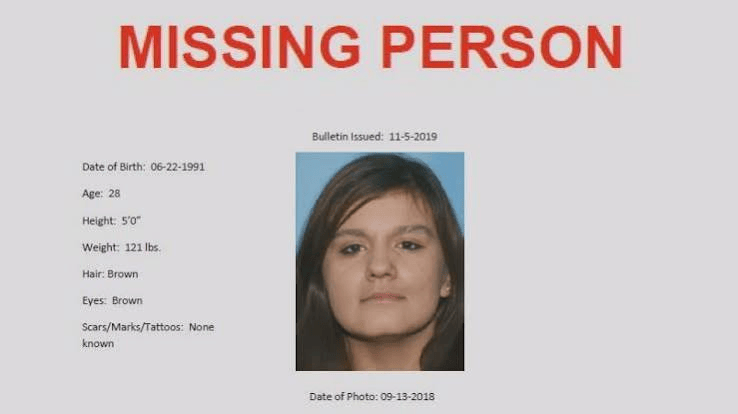
There are some cases where the word missing is only the beginning.
A family hears that their loved one has disappeared.
They wait for the phone to ring.
They hope she will walk through the door.
They hope there is an explanation.
Maybe her phone died.
Maybe she needed some time alone.
Maybe she is somewhere safe.
But sometimes the truth is much darker.
For 28 year old Alyssa M. Jimenez of Big Lake, Alaska, investigators initially believed they were searching for a missing woman whose safety was in danger.
They were right about that part.
But what they did not know yet was that Alyssa would never come home.
She had been killed.
And she was not the only victim.
The investigation would eventually become a triple homicide investigation involving Alyssa, 25 year old Michael Attwood and 37 year old Donna Marie Campos.
Today, Alaska State Troopers still list Alyssa’s death among the state’s unresolved homicides.
More than six years later, her family is still waiting for justice.
The cases may be cold.
The questions are still burning.
THE WEEKEND THAT CHANGED EVERYTHING
November 2, 2019 was a Saturday.
Somewhere around the Wasilla area, three people who knew one another were together.
Alyssa Jimenez.
Michael Attwood.
Donna Marie Campos.
Exactly what happened during those final hours remains one of the most important unanswered questions in this case.
According to Alaska State Troopers, Michael and Donna were discovered deceased on November 3 near Knik Knack Mud Shack Road.
Both had been shot.
Then investigators learned something that immediately changed the urgency of the investigation.
Alyssa had reportedly been with them.
She was missing.
And investigators were concerned for her safety.
At that moment, this was not simply a missing person investigation.
Something much more serious appeared to have happened.
THE SEARCH FOR ALYSSA
When authorities began searching for Alyssa, they did not know where she was.
Her disappearance was considered suspicious because she had reportedly been in the company of the two people who had already been found dead.
Investigators were essentially racing against time.
But there was a terrible reason for that concern.
Alyssa was already dead.
On November 5, Alaska State Troopers located the body of a woman near Mile 10 of Knik Goose Bay Road.
The remains were tentatively identified as Alyssa Jimenez.
She was 28 years old.
Her body had been found only a few miles from where Michael and Donna had been discovered.
Investigators announced that the three deaths were believed to be connected and were being treated as a homicide investigation.
The search for one missing woman had become a search for answers in three murders.
THREE PEOPLE
There is something about a case involving multiple victims that makes the questions even harder.
Why three?
Why these three?
Were they all targeted for the same reason?
Or did one person’s actions somehow lead to the deaths of the others?
Were the killings planned?
Was this an argument that escalated?
Was someone trying to eliminate witnesses?
Or was there another motive that investigators have never publicly revealed?
We know Alyssa, Michael and Donna knew one another.
Beyond that, much of the investigative picture has remained private.
And honestly, I understand why.
In an active homicide investigation, law enforcement cannot release every detail to the public.
Some information needs to remain confidential.
Some facts may be known only to the killer and investigators.
And those details can become incredibly important if the case eventually goes to trial.
THE PERSON OF INTEREST
Only days after the bodies were discovered, Alaska State Troopers announced that they wanted to speak with a man named Juan Camarena.
Camarena was described by authorities as a person of interest in the triple homicide investigation.
Troopers asked the public for help locating him.
He eventually contacted authorities and arranged to meet with them.
He was taken into custody on November 14, 2019, but it is extremely important to make something clear.
Camarena was not charged with the murders of Alyssa Jimenez, Michael Attwood or Donna Campos.
He was arrested on an unrelated federal warrant involving ammunition possession.
That distinction matters.
Being a person of interest does not mean someone is guilty.
It means investigators considered the person potentially relevant to the investigation.
According to federal prosecutors, authorities discovered ammunition in Camarena’s trailer during the homicide investigation.
Sixteen rounds were identified in the federal indictment, including 9mm, .40 caliber and .45 caliber ammunition.
Federal prosecutors also stated that .40 caliber casings had been found at the homicide scene.
That information certainly raises questions.
But questions are not convictions.
And as a Criminal Justice major, I think that distinction is incredibly important.
We have to separate what we suspect from what we can prove.
THE AMMUNITION QUESTION
This is one of the pieces of this case that I find particularly interesting.
Federal prosecutors said ammunition found in Camarena’s trailer included a .40 caliber round.
Investigators had also recovered .40 caliber casings from the homicide scene.
That is something investigators would obviously want to examine.
But caliber alone does not prove that ammunition came from the same firearm.
There are many firearms capable of firing the same caliber ammunition.
So the real question becomes:
Was there additional ballistic evidence?
Was a firearm ever recovered?
Could investigators match the markings on recovered bullets or casings to a particular firearm?
Was the ammunition connected through other forensic evidence?
Those are the kinds of questions that can transform a suspicion into evidence.
Or demonstrate that two seemingly connected pieces of evidence are actually unrelated.
A WOMAN WHO WAS TRYING TO HELP
One of the most heartbreaking details reported by Alaska’s News Source came from Donna Campos’s mother, Janene.
According to her account, Donna had gone to help Alyssa after learning that Alyssa was in trouble.
Janene said Donna was not the kind of person who would simply leave Alyssa alone.
She believed Donna went to get her.
Michael reportedly went with her.
And then all three would become victims.
If that account is accurate, it adds another devastating layer to this case.
Maybe Alyssa’s disappearance was not some isolated event.
Maybe the circumstances that brought the three people together that night are actually central to understanding the entire crime.
That is something I would want investigators to examine very closely.
WHAT HAPPENED IN THOSE FINAL HOURS?
This is where the timeline becomes incredibly important.
Alyssa was reportedly with Michael and Donna.
Michael and Donna were found dead.
Alyssa disappeared.
Then Alyssa was found dead a few days later.
That creates a window of time that investigators have to reconstruct.
Where were all three people?
Who saw them last?
Who contacted them?
Who was communicating with them?
What vehicles were involved?
Where did they travel?
Who knew where they were?
Was there an argument?
Did someone become frightened?
Did someone attempt to leave?
Did anyone try to get help?
And perhaps most importantly:
Who was the last person known to see Alyssa alive?
That person could potentially hold an incredibly important piece of the timeline.
MY CRIMINAL JUSTICE PERSPECTIVE
Now this is where I want to put on my Criminal Justice Major hat.
The following are my personal theories and investigative questions.
They are not facts.
I am not accusing anyone.
I am not saying that any particular person committed these murders.
These are simply the theories I would consider if I were looking at this case from an investigative and criminal justice perspective.
Theory One: Alyssa may have been connected to the motive
When three people are killed in the same general period, I immediately want to understand the relationship between the victims.
Were all three targeted equally?
Or was one person the primary target?
That distinction could completely change the investigation.
I would want investigators to examine Alyssa’s relationships, communications, friendships and conflicts in the weeks leading up to November 2.
Who was she talking to?
Who was she spending time with?
Was she worried about anyone?
Had she recently become involved in a conflict?
Was someone trying to contact her?
Victimology could be incredibly important here.
Theory Two: One victim may have been the primary target
Another possibility is that the three victims were not necessarily targeted for the same reason.
Maybe one person was the intended target and the other two were caught up in the situation.
Or perhaps the killer wanted all three dead.
Those are dramatically different scenarios.
If investigators can determine which victim was most likely targeted first, they may be able to narrow down motive.
I would want the crime scenes compared carefully.
The location of each body.
The injuries.
The ammunition.
The sequence of events.
The distance between the locations.
And any evidence that might establish whether the victims were killed together or separately.
Theory Three: Was someone trying to eliminate a witness?
This is one of the questions I would not ignore.
If the three people were together before the killings, investigators should consider whether someone killed one person and then realized another person had witnessed something.
That could potentially explain why multiple people were killed.
Again, this is only a theory.
There is nothing in the public record that allows me to say this happened.
But from a criminal justice perspective, witness elimination is something investigators should consider when multiple people connected to the same event are killed.
Theory Four: The timeline may be more important than the motive
Sometimes investigators become understandably focused on why a person was killed.
But before you can establish motive, you need to establish what happened.
I would want an extremely detailed timeline covering at least the 24 to 48 hours before the murders.
Every phone call.
Every text.
Every location.
Every known interaction.
Every vehicle movement.
Every witness.
Every piece of surveillance.
Every financial transaction that could establish movement.
Modern technology can sometimes make these timelines incredibly detailed.
Cellular records, surveillance footage, vehicle data and digital communications can potentially help establish where people were and when.
The question is whether enough of that evidence still exists.
Theory Five: Reexamine every piece of forensic evidence
This is a 2019 case.
That means much of the evidence is still relatively modern.
If biological evidence was collected, I would want investigators to determine whether additional testing could be performed.
If firearms evidence was recovered, I would want a complete ballistic review.
If clothing was preserved, I would want investigators to determine whether trace evidence or DNA could still be developed.
And if there are pieces of evidence that were considered insignificant years ago, I would want them looked at again.
Cold cases sometimes move forward because someone finds something new.
But sometimes they move forward because someone looks at something old in a completely different way.
THE BIGGEST QUESTION
For me, the biggest question is simple.
Why were three people killed?
We know they were together.
We know they died within the same general period.
We know investigators believe their deaths were connected.
But the public still does not know exactly what happened.
And that leaves an enormous hole in the story.
Alyssa was initially a missing woman.
Someone was supposed to find her.
Someone was supposed to bring her home.
Instead, investigators found her body.
That is a reality no family should ever have to face.
SOMEONE KNOWS SOMETHING
There is another part of cold case investigations that I always come back to.
Someone usually knows something.
Maybe they saw something.
Maybe they heard something.
Maybe they were told something.
Maybe they were afraid to speak.
Maybe they thought the person responsible would never be caught.
Maybe they have convinced themselves that too much time has passed.
But time does not erase murder.
And time does not erase victims.
Alyssa is still listed by the Alaska Department of Public Safety as an unresolved homicide.
Her case number is AK19075656.
Her name is still there.
And that means this case is still waiting for an answer.
ALYSSA DESERVES TO BE REMEMBERED
Alyssa Jimenez was 28 years old.
She was someone’s daughter.
Someone’s friend.
Someone’s loved one.
And according to people who knew her, she was a person worth caring about.
She should have had more birthdays.
More ordinary Saturdays.
More holidays.
More conversations.
More chances to change, grow and experience life.
Instead, her life ended violently.
And her family has been left with questions that have lasted for years.
That is what a cold case really is.
It is not an old story.
It is an unfinished story.
And Alyssa’s story is not finished.
UNTIL EVERY CASE IS SOLVED
If you know something about the deaths of Alyssa Jimenez, Michael Attwood or Donna Campos, please contact the Alaska State Troopers.
Even information that seems insignificant could potentially help investigators.
You may not know the entire story.
You may only know one piece.
But sometimes one piece is exactly what investigators need.
Alyssa was once reported as missing.
Her family wanted her found.
She was found.
But finding her was only the beginning.
Now they deserve to know who took her life and why.
Until Every Case is Solved.


Leave a comment