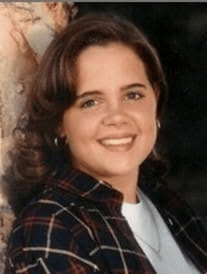
There are some cold cases where the first few hours are filled with hope.
A young woman doesn’t come home.
Her family starts calling.
Friends start searching.
Everyone tells themselves there has to be a reasonable explanation.
Maybe her car broke down.
Maybe she stopped somewhere.
Maybe she lost track of time.
Maybe she is going to walk through the door any minute.
But then the hours turn into days.
And hope starts fighting against fear.
That is what happened to Amanda Renee Tusing.
Amanda was only 20 years old.
She was engaged to her high school sweetheart.
She had dreams of helping animals.
Her family described her as outgoing, energetic and someone who loved sports.
On the night of June 14, 2000, Amanda left her fiancé’s apartment in Jonesboro, Arkansas, intending to drive home to her parents’ house in Dell.
She never made it.
Her car was found abandoned along Arkansas Highway 18.
Her purse was still inside.
Her keys were still there.
Her radio was still playing.
Her car was in working condition.
But Amanda was gone.
Three days later, her body was discovered in a rain swollen ditch.
What initially looked like a missing person case had become something much darker.
A murder investigation.
And twenty five years later, Amanda’s killer still has not been identified.
The cases may be cold.
The questions are still burning.
THE GIRL WHO WAS SUPPOSED TO COME HOME
Amanda Renee Tusing was born December 6, 1979.
Her family called her Mandy.
She grew up in Dell, Arkansas, alongside her twin brother and older brother.
Her father, Ed, later described her as a young woman who was full of energy.
She loved sports.
She participated in everything she could.
She was outgoing and personable.
And she had dreams.
One of those dreams was helping animals.
Another was building a life with the man she loved.
Amanda was engaged to her high school sweetheart, Matthew Ervin.
She was only about a year away from getting married.
That makes what happened next even harder to comprehend.
Because there was no indication that Amanda was planning to disappear.
She wasn’t walking away from her life.
She was trying to get home.
THE STORM
June 14, 2000 was a stormy night in northeast Arkansas.
Amanda was at Matthew’s apartment in Jonesboro.
At approximately 11:30 p.m., she decided to drive home to Dell.
The drive was roughly 40 miles.
On a normal night, it would have been a routine trip.
But this was not a normal night.
A severe storm had moved through the area.
Rain was falling heavily.
Visibility was poor.
The roads were wet.
And Amanda was driving alone.
She told Matthew that she would call once she arrived home.
That call never came.
By approximately 1:30 in the morning, concern had turned into fear.
Matthew contacted Amanda’s parents.
Amanda’s father, Ed, began searching from Dell while Matthew traveled from Jonesboro.
They were essentially searching the same road from opposite directions.
And eventually, they found her.
Or at least they found her car.
THE CAR ON HIGHWAY 18
Amanda’s 1992 Pontiac Grand Am was parked along Highway 18.
But something about the scene immediately felt wrong.
The vehicle wasn’t wrecked.
It wasn’t sitting in a ditch.
It wasn’t obviously disabled.
According to investigators, the car was in working condition and had gas.
The windshield wipers were still on.
The radio was tuned to the station Amanda listened to.
Her personal belongings were still inside.
Her purse was there.
Her keys were there.
A drink was sitting in the vehicle.
And there was no obvious sign of a struggle.
Amanda was simply gone.
Her father later described the discovery as a nightmare.
Because when you find someone’s vehicle sitting on the side of the road but the person who was driving it is nowhere around, your mind immediately starts creating possibilities.
Car trouble.
An accident.
A medical emergency.
Someone needing help.
An abduction.
You don’t know.
And Amanda’s family didn’t know.
All they knew was that she should have been home.
THE SEARCH
The search for Amanda began.
Family members searched.
Friends searched.
Law enforcement searched.
And for three days, they had no idea where she was.
Her father later talked about those days and the terrible uncertainty that came with them.
Was she alive?
Was she hurt?
Was someone holding her?
Was she somewhere waiting to be found?
Every possibility had to be considered.
Then, on June 18, everything changed.
A resident discovered Amanda’s body in a rain swollen ditch near the Twin Bridges area along Highway 135.
She was approximately 12 miles from where her vehicle had been found.
The missing person investigation was now a homicide investigation.
THE DISCOVERY OF AMANDA
The Arkansas State Police currently lists Amanda’s cause of death as drowning.
But that single word does not answer the bigger question.
How did Amanda end up there?
Why was her car abandoned miles away?
Who was responsible for her death?
And was the water actually the cause of her death, or was Amanda placed in the water after she had already died?
Those questions have haunted the investigation for decades.
Contemporary reporting noted that investigators found no evidence of sexual assault.
The scene also presented another enormous problem.
The storm.
Heavy rain can destroy evidence.
It can wash away footprints.
It can disturb tire tracks.
It can move objects.
It can contaminate or eliminate biological evidence.
It can turn a potentially useful crime scene into a forensic nightmare.
And Amanda’s killer may have benefited from exactly that.
THE STRANGEST PART OF THE CASE
For me, one of the most troubling aspects of this case is the condition of Amanda’s vehicle.
Think about it.
Her car was working.
She had gas.
Her belongings were still there.
The radio was still playing.
There was no obvious crash.
There was no obvious struggle.
And Amanda was gone.
That suggests that something happened after she stopped the car.
But why?
Did she stop voluntarily?
Did someone flag her down?
Did another vehicle force her to stop?
Did someone approach her?
Was she pulled over by someone she believed had authority?
Or did she willingly get into another vehicle?
Those questions have been debated for years.
But there is one theory that investigators have considered that I find particularly disturbing.
THE POSSIBILITY OF A POLICE IMPERSONATOR
Amanda’s family has believed that she may have been stopped by someone posing as a police officer.
Her father has specifically discussed the possibility that a person impersonating an officer could have convinced Amanda to stop.
Retired investigator Gary Etter also publicly discussed the possibility of someone knowing how to conceal evidence.
The theory makes sense in one respect.
A young woman driving alone late at night during a storm might reasonably pull over if she believed an officer was stopping her.
And if someone was impersonating law enforcement, they would potentially have an advantage.
They would not necessarily need to force a driver from the vehicle.
They could simply create the perception that the driver was required to stop.
But there is an important distinction.
There is no publicly established evidence proving Amanda was stopped by a police officer or someone impersonating one.
It remains a theory.
And that distinction matters.
MY CRIMINAL JUSTICE PERSPECTIVE
Now I want to put on my Criminal Justice Major hat.
Everything that follows is my personal opinion and my own investigative theories.
These are not facts.
I am not accusing anyone.
I am not saying that a particular person killed Amanda.
I am looking at the circumstances and asking what I would want investigators to examine if I were approaching this case with fresh eyes.
THEORY ONE: Amanda may have been intentionally stopped
This is probably the theory I find most compelling.
Not because we can prove it.
We cannot.
But because of the condition of her car.
If Amanda had experienced car trouble, you would expect some indication of a mechanical problem.
But investigators found that the vehicle was operational.
If she had been involved in an accident, you would expect evidence of an accident.
There wasn’t.
Instead, the car was simply parked.
That makes me wonder whether Amanda intentionally stopped because someone gave her a reason to stop.
That could have been another driver.
Someone she knew.
Someone asking for help.
Or someone impersonating law enforcement.
I would want investigators to reconstruct the exact location of the car and examine what a driver could see from that position.
What businesses were nearby?
What homes?
What roads?
What entrances?
What lighting existed?
What would Amanda have seen from the driver’s seat?
And what would another driver have seen approaching her?
THEORY TWO: The killer may have been someone Amanda did not know
Another possibility is that Amanda was targeted by a stranger.
There is nothing publicly available that establishes a personal motive.
That makes me consider the possibility that this was opportunistic.
Perhaps someone saw a young woman traveling alone.
Perhaps they followed her.
Perhaps they waited for an opportunity.
Perhaps they created a reason for her to stop.
If that were the case, victimology becomes extremely important.
Investigators should look at Amanda’s routine.
Her route.
Her schedule.
Places she regularly visited.
Times she typically traveled.
And whether anyone could have known that she would be driving alone that night.
THEORY THREE: The storm may have destroyed the evidence the killer left behind
This is something I think deserves more attention.
The weather was terrible.
Heavy rain can be a criminal investigator’s nightmare.
Imagine a person leaving footprints behind.
Then imagine hours of heavy rain washing over those footprints.
Imagine tire tracks being disturbed.
Imagine fibers, hairs or other trace evidence being moved or destroyed.
A crime scene that might have contained valuable evidence could have been altered by nature before investigators even realized they were dealing with a homicide.
That does not mean there was no evidence.
It means the evidence may have been harder to recover.
And if the killer understood that weather was working in their favor, they may have benefited from circumstances completely outside their control.
THEORY FOUR: The location of Amanda’s body may tell us something about the killer
Amanda’s vehicle was found along Highway 18.
Her body was discovered near Highway 135.
Those locations are approximately 12 miles apart.
And Amanda was traveling toward Dell when she disappeared.
Her body was found in a different direction from where she had been heading.
That is significant to me.
Why move her?
Was the body dumped there because the killer knew the area?
Was it chosen because it was isolated?
Was it simply convenient?
Did the killer have a connection to the location?
Or was the body moved because the killer did not want it found near the vehicle?
I would want investigators to look very closely at anyone who had a connection to both areas.
Employment.
Family.
Property.
Regular travel routes.
Hunting.
Fishing.
Recreation.
Anything.
Sometimes geography can tell investigators something about a person’s familiarity with an area.
THEORY FIVE: Reexamine the case with today’s technology
This is where I think there is genuine hope.
In 2023, Craighead County assigned Detective David Bailey specifically to Amanda’s case.
The sheriff’s office said investigators were essentially starting over.
They reviewed old interviews.
They conducted new interviews.
They reviewed crime scene photographs.
They went through the evidence again.
And investigators specifically discussed technology that exists today that did not exist in 2000.
That is exactly what I want to hear in a cold case.
Fresh eyes.
Not because the original investigators did not care.
But because investigators today have tools that investigators in 2000 simply did not have.
Phone records.
Cellular location information.
Advanced DNA analysis.
Improved forensic databases.
Better digital reconstruction.
More sophisticated evidence review.
And sometimes an old piece of evidence becomes valuable because technology finally catches up with it.
THE QUESTION OF MOTIVE
One of the hardest parts of Amanda’s case is motive.
Why her?
Was it personal?
Was it random?
Was she targeted because of something someone knew about her?
Was the killer watching her?
Was she simply in the wrong place at the wrong time?
We don’t know.
And that is why I would be careful about becoming too attached to any single theory.
Cold cases can be dangerous when we decide we know the answer before the evidence tells us.
As someone studying Criminal Justice, one of the biggest lessons I have learned is that an investigator has to be willing to follow the evidence even when it takes them somewhere unexpected.
Sometimes the theory you start with is completely wrong.
Sometimes the smallest piece of evidence changes everything.
A FAMILY THAT NEVER STOPPED LOOKING
Amanda’s family never simply forgot about her.
They kept asking questions.
They kept looking for answers.
They kept talking about Mandy.
Her father Ed has continued to speak publicly about the case.
Amanda’s mother, Susan, spent years searching for answers before she died in 2021.
She never stopped wanting to know what happened to her daughter.
There is a quote from Amanda’s mother that really stays with me.
She said:
“I refuse to let whoever did it destroy my family.”
That is what a mother sounds like when she refuses to allow a killer to have the final word.
And she shouldn’t have to.
TWENTY FIVE YEARS LATER
Twenty five years.
That is a long time.
People who were children in 2000 are now adults.
People who were teenagers are now middle aged.
Technology has transformed almost every part of our lives.
But Amanda’s family is still waiting for the same thing they wanted in 2000.
An answer.
The Arkansas State Police still list Amanda Renee Tusing as an unresolved homicide.
Her official case number is CID F 00017 00.
Anyone with information is asked to contact Arkansas State Police Company F at 870 931 0043.
And I think that is important to remember.
This case is not closed.
Amanda’s name is still in the system.
Her case is still considered unresolved.
And investigators are still willing to hear from people who know something.
SOMEONE MAY STILL KNOW
Maybe someone remembers seeing Amanda’s car that night.
Maybe someone remembers seeing another vehicle near Highway 18.
Maybe someone remembers a strange conversation.
Maybe someone heard something years ago.
Maybe someone knows something about the area where Amanda’s body was discovered.
Maybe someone was told something by the person responsible.
And maybe that person has spent twenty five years telling themselves that it is too late to speak.
It isn’t.
There is no expiration date on the truth.
AMANDA WAS SUPPOSED TO COME HOME
That is the part of this case I keep coming back to.
Amanda wasn’t going somewhere mysterious.
She wasn’t planning a new life.
She wasn’t disappearing.
She was going home.
She was supposed to call her family when she arrived.
Instead, her family found her car.
Then they found her body.
And twenty five years later, they still don’t know who took her life.
Amanda should have gotten married.
She should have had birthdays.
She should have watched her family grow.
She should have had the opportunity to become everything that 20 year old girl dreamed she could become.
Instead, someone else’s actions took all of that away.
And whoever did it has lived more than two decades knowing the truth.
Amanda’s family has lived more than two decades without it.
That is not justice.
UNTIL EVERY CASE IS SOLVED
If you know something about the death of Amanda Renee Tusing, please contact the Arkansas State Police at 870 931 0043.
You don’t have to know everything.
You don’t have to have every answer.
You may only have one small piece.
But sometimes one small piece is exactly what investigators need.
Amanda was someone’s daughter.
Someone’s sister.
Someone’s twin.
Someone’s fiancée.
Someone’s friend.
And she deserves to be remembered as more than an unsolved case number.
She deserves her story.
She deserves the truth.
And she deserves justice.
Until Every Case is Solved.


Leave a comment