The Disappearance of Angela “Angie” Hammond
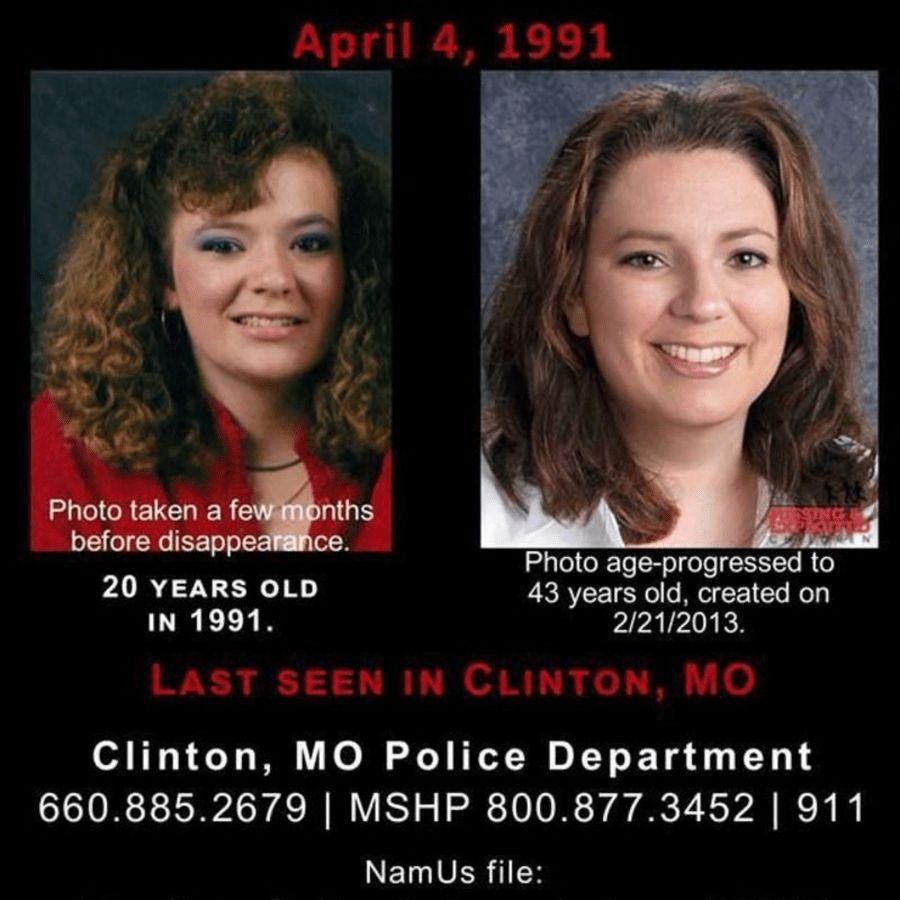
NAMUS
NAMUS
By Cold Cases After Dark
There are some crimes that unfold in silence.
Angela Hammond’s did not.
Her boyfriend heard her scream.
He raced toward her.
He saw the truck believed to be carrying her away.
He heard her call his name.
And then, in one of the most devastating twists imaginable, his vehicle failed during the pursuit.
Angela disappeared into the Missouri night.
More than 35 years later, she has never been found.
A Young Life About to Change
Angela Marie “Angie” Hammond was 20 years old when she vanished from Clinton, Missouri.
She was 4 feet 11 inches tall and weighed approximately 140 pounds. She had brown eyes and blond hair, according to the Missouri Missing Persons Clearinghouse. [1]
Her life was changing.
Angela was pregnant.
She was preparing for a future that should have included raising her child, building a family, celebrating birthdays and growing older.
Instead, she became frozen in time at 20 years old.
Today, the Missouri State Highway Patrol still lists Angela as an active missing person, with the Clinton Police Department identified as the investigating agency. [1][2]
April 4, 1991
The night began without any indication that Angela was about to become the center of one of Missouri’s most haunting mysteries.
According to the official Missouri Missing Persons Clearinghouse poster, Angela was last seen by her boyfriend at approximately 10 p.m. after she dropped him off at his home following a date. [1]
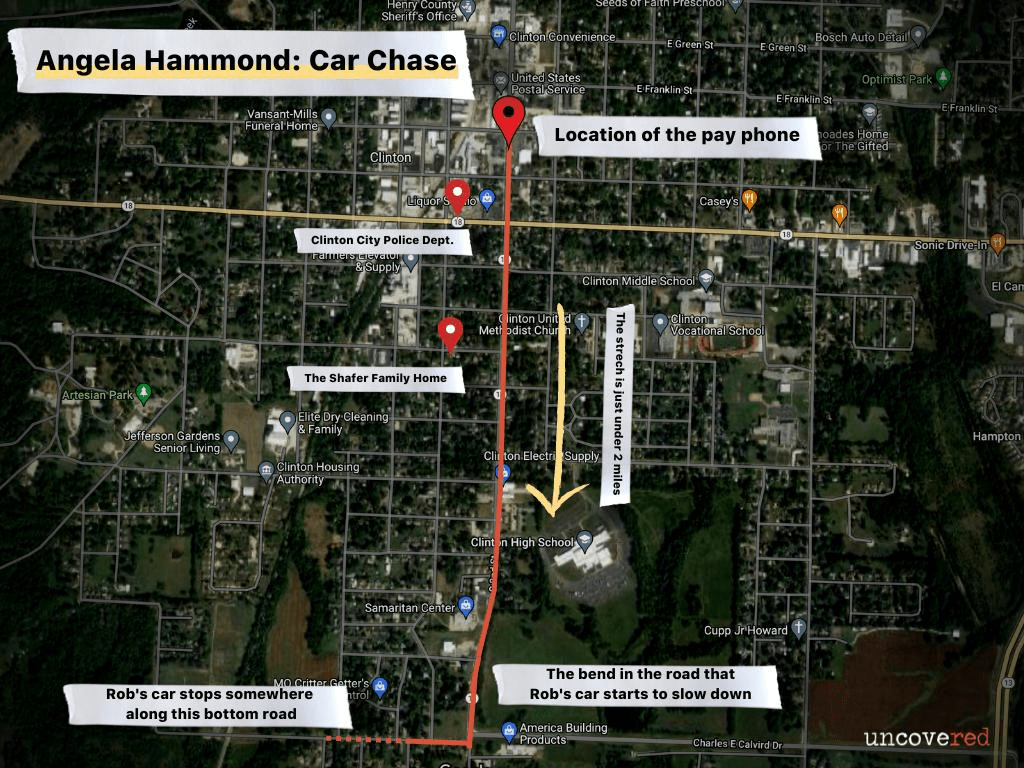
Later that night, at approximately 11:15 p.m., Angela called him from a payphone in downtown Clinton.
It is difficult to imagine today just how ordinary that was.
There were no smartphones.
No constant GPS tracking.
No text messages.
No location-sharing apps.
If you needed to call someone while away from home, you found a payphone.
And that is what Angela did.
During the conversation, however, she noticed something strange.
A truck.
The Green Truck
Angela told her boyfriend about an older-model, two-tone green pickup truck that kept circling the block.
The truck reportedly had an unusual and potentially memorable feature: a fishing mural on the rear window.
Then the truck stopped.
A bearded man wearing coveralls got out and approached the area near the phone booth. [1]
Angela continued speaking on the telephone.
Then she screamed.
The line went dead.
Her boyfriend immediately got into his vehicle and raced toward the payphone.
What happened next is almost impossible to read without wondering how differently this case might have ended if only one mechanical part had held together for a few more minutes.
According to the official case poster, he encountered the same two-tone green truck.
Angela screamed his name as the vehicle sped away.
He attempted to follow.
But the pursuit ended.
Angela was gone. [1]
The Search for Angela
The disappearance of a young pregnant woman from a small Missouri community generated an enormous investigation.
Police searched.
Tips came in.
The truck description was publicized.
Investigators pursued leads.
But no confirmed trace of Angela was found.
No verified location.
No confirmed remains.
No answer.
And the image of that truck—a green pickup with a distinctive fishing scene—became permanently connected to her disappearance.
It seems like the kind of detail someone should remember.
Someone may have painted that mural.
Someone may have ridden in that truck.
Someone may have repaired it.
Someone may have watched its owner suddenly remove or cover the image after April 1991.
Yet the vehicle has never publicly provided the breakthrough needed to bring Angela home.
A New Theory Decades Later: Was Angela the Wrong Target?
For years, Angela’s disappearance appeared to be a terrifying stranger abduction.
Then investigators revealed another possibility.
What if Angela Hammond was never the intended victim?
In 2021, on the 30th anniversary of her disappearance, Clinton investigators publicly discussed a theory involving mistaken identity. Investigators had developed information suggesting that another young woman named Angela—who reportedly bore some resemblance to Hammond—may have been the intended target of a retaliatory kidnapping connected to her father’s cooperation against a criminal enterprise.
Under that theory, the kidnappers may have come to Clinton looking for one “Angie” and abducted the wrong young woman.
Angela Hammond may have been taken because of a name.
A resemblance.
And a catastrophic mistake.
The theory has not been proven, but investigators have said information developed during the investigation gave it enough credibility that they could not simply dismiss it.
My Perspective as a Criminal Justice Major
The following section contains my personal analysis and theories. These are not established facts and should not be interpreted as accusations against any particular person.
Angela’s case fascinates and frustrates me from a Criminal Justice perspective because investigators possess something many cold cases do not:
A real-time description of the suspected offender and vehicle immediately before the abduction.
Yet Angela still vanished.
The mistaken-identity theory also changes how I look at nearly every detail of that night.
Theory One: The Truck May Have Been Searching for Someone, Not Simply Cruising
Angela reportedly noticed the truck circling the area.
Why?
The traditional interpretation is that a predator saw Angela and began watching her.
But if the mistaken-identity theory is correct, the repeated circling could mean something different.
Perhaps the person in the truck was searching.
Maybe the offender had only a vague physical description.
A first name.
A general location.
A description of where the intended target might be found.
If Angela resembled the intended victim, the offender may have circled the area while trying to determine whether she was the person they had been sent to find.
That could explain why the encounter may have appeared both random and strangely deliberate.
Theory Two: The Distinctive Truck May Not Have Belonged to the Abductor
One question I would ask is whether investigators focused primarily on finding the owner of the truck when the more important question may have been:
Who had access to it that night?
Vehicles can be borrowed.
Loaned.
Stolen.
Purchased without immediately transferring paperwork.
Shared between relatives or coworkers.
If the offender was involved in organized criminal activity, using a vehicle registered directly in his own name would have created an obvious investigative trail.
The truck may have belonged to someone who had no idea how it was being used—or someone who later chose silence.
Theory Three: The Fishing Mural May Have Been Removed Immediately
The rear-window image was highly distinctive.
That makes it valuable evidence.
It also makes it dangerous for the offender.
Once Angela’s disappearance became public and the truck description circulated, the person responsible would have had a powerful reason to change the vehicle’s appearance.
The mural could have been removed.
The truck could have been repainted.
The vehicle could have been dismantled or abandoned.
I would be interested in records from body shops, salvage yards and vehicle sales shortly after the abduction, although I recognize that reconstructing those records more than three decades later would be extraordinarily difficult.
The key may never have been finding the truck exactly as Angela described it.
The key may have been finding a truck that used to look that way.
Theory Four: The Offender May Not Have Expected Angela to Be on the Phone
This is one of the details I keep returning to.
If Angela was targeted—or mistaken for someone who was targeted—did the offender know she was actively speaking to another person?
If not, the abductor unknowingly allowed Angela to create a real-time witness.
Her boyfriend heard the events unfold.
He received a description of the truck.
He knew something was wrong almost immediately.
That forced the offender into a much tighter timeline.
It also makes me wonder whether the abduction happened impulsively once the offender believed he had located the intended target.
Theory Five: More Than One Person May Have Been Involved
If the mistaken-identity theory involves retaliation connected to a criminal enterprise, I question whether one person planned and carried out everything alone.
There could have been a person who identified the target.
Another who supplied information.
Someone who provided a vehicle.
And someone who physically carried out the abduction.
That does not mean every participant would have known what ultimately happened to Angela.
In fact, fragmented knowledge may help explain why a case can remain unsolved for decades.
One person may know who ordered it.
Another may know who drove the truck.
Another may know where Angela was taken.
No single witness may believe they know enough to solve the entire case.
But together, those fragments could tell the story.
Theory Six: The Wrong-Target Theory Could Explain the Lack of an Obvious Personal Motive
One of the first things investigators examine is the victim’s life.
Relationships.
Conflicts.
Family.
Work.
Recent behavior.
But if Angela was taken because someone confused her with another person, searching her personal life for a motive would never lead to the answer.
That is what makes mistaken-identity crimes so difficult.
The motive belongs to someone else’s life.
The victim may have absolutely no connection to the people responsible.
From an investigative standpoint, that can send detectives down logical paths that lead nowhere, not because the investigation is poor, but because the crime itself is based on a false assumption by the offender.
The Moment That Still Haunts This Case
There is one part of Angela’s story that is almost unbearable.
Help was coming.
Her boyfriend was close.
The suspected truck passed him.
Angela reportedly screamed his name.
For a moment, there was still a chance.
Then the pursuit failed.
It is easy, with hindsight, to focus on what might have happened if the vehicle had kept running.
But the responsibility for Angela’s disappearance belongs to the person or people who took her.
The tragedy is that the distance between rescue and disappearance may have been measured in seconds.
Angela Is Still Missing
Angela Hammond disappeared on April 4, 1991.
She was 20 years old.
She was pregnant.
She had plans.
She had people waiting for her.
More than three decades later, the Missouri State Highway Patrol still lists her as an active missing person. [1][2]
Somewhere, there may still be a person who remembers the green truck.
Someone may remember its fishing mural.
Someone may know why it suddenly changed appearance or disappeared.
And if the mistaken-identity theory is correct, someone may have heard a story about a kidnapping that went terribly wrong because the wrong “Angie” was taken.
The smallest piece of information may be the piece investigators have been missing.
Angela deserves to be found.
Her family deserves answers.
And the child whose future disappeared with her deserves to be remembered too.
At Cold Cases After Dark, we tell these stories because time does not erase what happened—and it should never erase the people still waiting to be found.
Angela “Angie” Hammond is still missing. Her story is still unfinished.
Until every case is solved.
If you or anyone you know has any information, please reach out to:
Phone: Call (660) 885-2679
Email: tips@clintonmopd.com
National Center for Missing & Exploited Children (NCMEC): Call 1-800-843-5678 or view the NCMEC Missing Child Poster. [1, 2, 3]


Leave a comment