The Unsolved Murder of Robert “Bob” Charles Gaurrich
WPXI
By Cold Cases After Dark
A mechanic spends his life fixing things.
Engines that will not start.
Brakes that have failed.
Machines that other people have given up on.
But on the night of January 11, 2013, something happened inside a small auto repair shop in Butler County, Pennsylvania, that no one has been able to fix.
Robert Charles “Bob” Gaurrich was shot.
Investigators believe he tried to escape.
He made it outside.
But he did not make it home.
And when police began searching for answers, one of Bob’s own rifles was missing.
More than thirteen years later, the gun is still a crucial piece of an unsolved murder mystery—and someone still knows what happened inside Bob’s shop that night.
The Man Behind the Garage
Robert Charles Gaurrich was 45 years old.
Born on August 31, 1967, Bob was the son of Howard and Sharon Gaurrich. He owned and operated Bob’s Truck & Auto Repair, Inc., near Evans City, Pennsylvania. His obituary remembered a man who enjoyed camping, hunting, fishing, family holidays, and fireworks.[1]
Those who knew Bob described him as generous and willing to help others. In contemporary news coverage, his fiancée described him as someone who would do anything for another person.[2]
That matters.
Because before Robert Gaurrich became the victim at the center of a cold case, he was simply Bob.
A son.
A brother.
A partner.
A business owner.
A mechanic people trusted with their vehicles.
Then came Friday, January 11, 2013.
The Last Hours
At approximately 11:20 p.m., Pennsylvania State Police were called to Bob’s Truck & Auto Repair on Evans City Road in Forward Township.
Bob had been found outside the business.
He was lying face down on a gravel pile behind the repair shop.
He had been shot.[3]
Investigators would eventually develop a haunting reconstruction of what may have happened.
They believe Bob was shot inside his business.
Then, wounded, he apparently tried to get away from whoever had attacked him.
He made his way through the east main door.
He reached the area behind the shop.
And there, his escape ended.[3]
Imagine those final moments.
A place Bob knew better than almost anyone.
His own business.
His own tools.
His own doors.
A place where he should have been safe.
Suddenly transformed into a crime scene.
No Sign of Forced Entry
One of the most important details reported early in the investigation was what police apparently did not find.
There was no reported sign of forced entry.[2][3]
That raises questions.
Did Bob know the person who came into his shop?
Was the business still open to someone expected to arrive?
Did the killer enter under an innocent pretense?
Or was access to the shop simply possible without forcing a door?
Police have never publicly identified a killer.
But investigators immediately began looking for something else.
A missing rifle.
The Winchester
Bob owned a distinctive firearm: a Winchester Canadian Centennial .30-30 lever-action rifle.
After the homicide, the rifle was missing.
According to Pennsylvania State Police, it had an octagonal barrel approximately 26 to 28 inches long and was stamped “1867–1967.” It had a wooden stock, wood putty on part of the forearm, a broken sling ring, and other identifying characteristics.[3]
Investigators also recovered a .30-30 caliber shell casing near a garage door.[4]
Early reporting indicated that police were investigating whether the missing rifle could have been connected to Bob’s death.[4]
The weapon has remained one of the most important mysteries in the case.
Was it the murder weapon?
Was it stolen after the shooting?
Was the rifle the reason someone came to the shop in the first place?
Or was its disappearance intended to make the crime look like a robbery?
Those questions remain unanswered publicly.
Was Someone Coming to See the Rifle?
One particularly intriguing detail emerged in early news coverage.
According to reporting at the time, someone was reportedly expected to stop by the shop to discuss buying the rifle.[5]
If accurate, that detail changes how I look at the case.
A valuable or collectible firearm can create a legitimate reason for a stranger—or an acquaintance—to enter a business.
No forced entry would be necessary.
No immediate suspicion.
Just a meeting.
A conversation.
A transaction.
And then something goes terribly wrong.
Police have not publicly established that a potential gun sale was the motive for Bob’s murder.
But more than a decade later, the missing Winchester remains a central piece of the investigation.
A Cold Case, and a Renewed Reward
The years passed.
No arrest.
No public identification of the killer.
But the case was not forgotten.
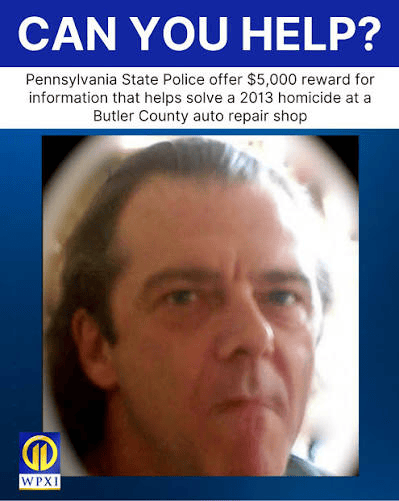
Pennsylvania State Police continued investigating, and Pennsylvania Crime Stoppers later offered a $5,000 reward for information that leads to solving the case.[3]
Investigators continue to seek information about both Bob’s homicide and the missing Winchester rifle.
More than thirteen years later, that rifle could still be somewhere.
In a gun safe.
In a private collection.
Passed from one person to another.
Inherited by someone who has no idea where it came from.
Or hidden because someone knows exactly what it represents.
My Perspective as a Criminal Justice Major
The following section contains my personal analysis and theories. These theories are not established facts and should not be interpreted as accusations against any individual.
What stands out to me about Bob’s case is the apparent combination of three things:
No reported forced entry.
A missing distinctive rifle.
And evidence suggesting Bob tried to escape after being shot.
Those facts create several possibilities.
Theory One: The Rifle May Have Been the Bait
If someone was genuinely expected to discuss buying the Winchester, I wonder whether the proposed transaction was used to create access to Bob.
A person interested in purchasing a firearm would have a perfectly reasonable excuse to visit the shop.
The meeting might not have appeared threatening.
Bob may have retrieved or displayed the rifle himself.
If the visitor already intended violence, the meeting could have placed the weapon within immediate reach.
Under this theory, the killer did not need to break into the business.
Bob may have willingly allowed the person inside.
Theory Two: The Missing Rifle Could Have Been Taken to Create a False Motive
Another possibility is that the rifle was not the original reason for the murder.
Perhaps it was taken afterward.
If someone killed Bob because of a personal dispute, debt, grievance, or another motive, removing a valuable firearm could make the scene appear to involve robbery.
In criminal investigations, what is missing from a crime scene can sometimes be as important as what remains.
The question I would ask is:
Was anything else valuable left behind?
If expensive tools, cash, equipment, or other easily stolen property remained untouched while only one highly distinctive rifle disappeared, that could suggest the weapon itself had special significance.
Theory Three: Bob May Have Recognized the Threat Too Late
The apparent absence of forced entry makes me wonder whether the interaction began normally.
Maybe there was a conversation.
Maybe Bob knew the person.
Maybe the visitor had been inside the shop before.
Then something changed.
If investigators are correct that Bob was shot inside and tried to escape through the east main door, his movement may reveal something about the sequence of events.
He was apparently not immediately incapacitated.
He tried to survive.
That raises questions about where everyone was standing, how close the shooter was, and whether the shooting followed an argument or sudden confrontation rather than an immediate ambush.
Theory Four: The Rifle May Have Changed Hands Several Times
More than a decade has passed.
Even if the killer originally took the Winchester, the person who possesses it today may have had absolutely nothing to do with Bob’s murder.
The rifle could have been sold privately.
Traded.
Given away.
Inherited.
Stored and forgotten.
That is why the detailed physical description matters.
The unusual barrel.
The anniversary markings.
The wood putty.
The broken and missing hardware.
Those imperfections may be more valuable for identification than the model number alone.
Someone could recognize that rifle without ever realizing they are holding evidence from a homicide.
Theory Five: The Killer May Have Been Familiar With Bob’s Schedule
Small businesses often develop routines.
Regular closing times.
Regular customers.
Predictable periods when the owner works alone.
If Bob was targeted rather than randomly encountered, the offender may have known when he would be at the shop and when there would be fewer witnesses.
That does not necessarily mean the killer was a close friend.
A customer can learn a routine.
A delivery person can learn a routine.
Someone who drives past regularly can learn a routine.
Familiarity does not always mean intimacy.
Theory Six: The Answer May Be in an Old Conversation
Cold cases are sometimes solved because evidence changes.
Other times, people change.
Relationships end.
Friendships collapse.
Loyalties disappear.
Someone who protected another person in 2013 may feel very differently in 2026.
Perhaps someone remembers a confession.
A sudden possession of an unusual Winchester rifle.
A person who needed clothing cleaned or destroyed.
A strange late-night arrival.
A vehicle that appeared at an unexpected time.
The witness who solves this case may not have witnessed the murder.
They may have witnessed what happened afterward.
The Gun May Still Be the Key
There is something almost symbolic about the missing Winchester.
Bob repaired vehicles for a living.
He worked with objects that had histories—machines passed from owner to owner, repaired, sold, and used again.
His rifle may have followed a similar path.
If it still exists, someone may possess it today without knowing its history.
That person may see an old lever-action rifle.
Investigators may see a missing piece of January 11, 2013.
And Bob’s family may see the possibility of finally learning who took him from them.
More Than a Cold Case
Robert Gaurrich was 45 years old when he was killed.
His obituary remembered his love of camping, hunting, fishing, family holidays, and fireworks.[1]
Those details may seem small.
They are not.
Cold cases are often reduced to dates, evidence, weapons, and unanswered questions.
But victims were people before they were case files.
Bob had a family.
A business.
Customers.
Friends.
A life that should have continued beyond a Friday night in January.
Instead, someone entered his world and left him dying behind the business he had built.
More than thirteen years later, no one has been publicly held accountable.
The Winchester remains missing.
The questions remain.
And somewhere, someone may still know exactly what happened.
At Cold Cases After Dark, we tell these stories because time does not make a murder less important.
Robert “Bob” Gaurrich deserves justice. His family deserves answers. And whoever knows what happened inside that repair shop has carried the truth long enough.
UNTIL EVERY CASE IS SOLVED.
References
[1] The Times. (2013, January 14). Robert Gaurrich obituary. Legacy.com. The obituary provides biographical information about Robert Charles Gaurrich, his family, business, and interests.
[2] WPXI. (2013, January 14). Woman finds boyfriend fatally shot outside auto repair shop. Contemporary reporting includes statements from Bob’s fiancée and early details from the homicide investigation.
[3] WPXI. (2026, March 22). State police offer $5K reward for info that solves case of Butler County auto repair shop shooting. This report provides the renewed reward information, the Pennsylvania State Police reconstruction of Bob’s attempted escape, and the detailed description of the missing Winchester rifle.
[4] WTAE. (2013, January 16). Butler County garage owner found shot to death. Contemporary reporting on the missing Winchester rifle and the .30-30 caliber shell casing recovered during the investigation.
[5] Cranberry Patch. (2013, January 14). Police ask for public’s help in solving Evans City homicide. Contemporary coverage of the investigation, including reporting that someone was expected to discuss buying the rifle.


Leave a comment